Zak Washington’s Guide to England: Introduction (English Lesson & Cultural Guide)
A SATIRICAL AND SUBVERSIVE GUIDE TO THE
ENGLISH LANGUAGE & BRITISH CULTURE
FOR B1-C2 LEVEL FOREIGN STUDENTS
Recommended age: 16 +
ACADEMIC NOTE: This site contains some brief linguistic analysis of expletives and taboo language for educational purposes only.
Content intended for adult researchers and linguistics students.

Original content created by Miki Pannell, professional linguist with PhD-level training and qualifications in :
- English Language and Linguistics, Certificado de Tercer Ciclo (Universidad de Sevilla)
- B.A. Hons. Spanish with English and Literary Studies (Middlesex University)
- TESOL Certificate [Teaching English as a Second Language] (Oxford House College)
Professional profile: https://www.linkedin.com/in/communicationswhizz/

VIDEO INTRODUCTION (Difficult C2 level)
ZAK WASHINGTON'S INTRODUCTION - EASY AUDIO
ZAK WASHINGTON'S INTRODUCTION - EASY AUDIO
(TEXT VERSION OF VIDEO)
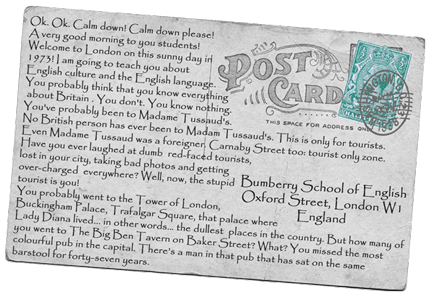
ZAK WASHINGTON: Ok. Ok. Calm down! Calm down please!
A very good morning to you students! Welcome to London on this sunny day in 1973!
I am going to teach you about English culture and the English language.
You probably think that you know everything about Britain [1]. You don't. You know nothing.
You've probably been to Madame Tussaud's. No British person has ever been to Madam Tussaud's.
This is only for tourists. Even Madame Tussaud was a foreigner.
Carnaby Street too: tourist only zone.
Have you ever laughed at dumb [2] red-faced tourists, lost in your city, taking bad photos and getting over-charged [3] everywhere? Well, now, the stupid tourist is you!
You probably went to the Tower of London, Buckingham Palace, Trafalgar Square, that palace where Lady Diana lived...
in other words… the dullest [4] places in the country.
But how many of you went to The Big Ben Tavern on Baker Street?
What? You missed the most colourful pub in the capital.
There’s a man in that pub that has sat on the same barstool for forty-seven years.
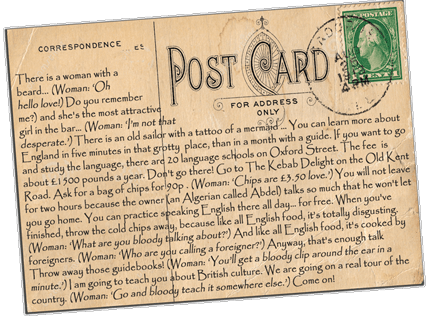
There is a woman with a beard... (Woman: ‘Oh hello love! Do you remember me?)
and she's the most attractive girl in the bar… (Woman: ‘I’m not that desperate.’)
There is an old sailor with a tattoo of a mermaid [5]…
You can study more about England in five minutes in this grotty [6] place, than in a month with a guide.
If you want to go and study the language, there are twenty language schools on Oxford Street.
The fee [7] is about £1500 pounds a year. Don't go there!
Go to The Kebab Delight on the Old Kent Road.
Ask for a bag of chips for 90p [8]. (Woman: ‘Chips are £3.50 love.’)
You will not leave for two hours because the owner, an Algerian called Abdel, talks so much that he won't let you go home.
You can practice speaking English there all day… for free.
When you've finished, throw the cold chips away, because like all English food, it’s totally disgusting.
(Woman: ‘What are you bloody talking about?’)
And like all English food, it's cooked by foreigners.
(Woman: ‘Who are you calling a foreigner?’)
GLOSSARY & USAGE - AUDIO
(TEXT VERSION)
Here's the VOCABULARY and EXPLANATIONS from the introduction
[1] Great Britain, United Kingdom, England, British Isles etc. Great Britain is the large island that is north of France, and east of Ireland.
It contains three autonomous regions: England, Wales and Scotland. Great Britain and Northern Ireland, together, are called the United Kingdom (The U.K.), which is, officially, the name of the country.
The official title that you can find on a passport is The United Kingdom of Great Britain and Northern Ireland. Ireland (or Eire) is a separate country altogether. Confused? Us natives are too.
The British Isles refers to both the large islands, and therefore includes Ireland too, but this expression is used only in relation to geography. This is all according (SP: según IT: secondo) to the ‘official’ description.
Natives of Britain often think in different ways. If you ask any Englishman, or Welshman where he’s from, he will tell you England, or Wales, not the United Kingdom.
Nobody except tourists say, ‘Are you from the United Kingdom?’
We seldom refer to ourselves as British either, probably because it has political connotations .
It is much less common to see the British flag (SP: bandera IT: bandiera) the Union Jack-(the red, white, and blue one) hanging (SP: colgar IT: appendere) in public places, as it is to see the American flag in the US. This can be a political statement (SP: declaración IT: dichiarazione).
The easiest and safest way is to refer to each individual country or nationality.
Thus England/English, Scotland/Scottish, Wales/Welsh, Northern Ireland/Northern Irish.
All of these people could be called Britons, Brits, British, or more unusually, Britishers. Britons is uncommon outside of newspapers and formal styles.
Brits is a popular word with non-Brits, and is informal; ‘He was running around drunk (SP: borracho IT: ubriaco) on the beach like a typical Brit abroad.’
Britisher is an ugly (SP: feo IT: brutto) word that is only usually heard outside Britain too.
British is the most universal and acceptable way of talking about the person’s nationality.
It describes the people, but can be used as an adjective for anything else too:
‘British weather is so bad, but when it rains, a lot of British men go out without their umbrellas. Why?’
Also note that there is no adjective for someone from the United Kingdom, which considering this is the official name of the country, is absurd!
[2] Dumb (adj.) (SP: tonto IT: scemo) 1. Stupid, idiotic. 2. Unable to talk.
[3] (to) Over-charge (SP: cobrar di más IT: fare pagare molto caro) to ask more money for something than the normal price. Tourist prices!
[4] Dull (adj.) (SP: aburrido IT: noioso) boring, tedious, uninteresting.
[5] Mermaid (noun) (SP: sirena IT: sirena) half topless woman, half fish.
[6] Grotty (adj.) (SP: cutre, sucio IT: sporco, sgradevole) describes something that is dirty, ugly and without much charm.
If someone told you about a grotty hotel, you definitely wouldn’t want to stay there, as it would be unpleasant and of bad quality.
You might enjoy staying at a sleazy (SP: sórdido IT: immorale, peccaminoso) hotel a little more, as the meaning of this adjective is more to do with ‘immoral’ or ‘dishonest’ behaviour.
There are probably sex workers, drugs, or some kind of corrupt, illegal activity happening there.
Sleazy doesn’t necessarily mean that the sheets (SP: sabanas IT: linzuoli) will be dirty.
Seedy is a synonym.
A tacky (SP: hortera IT: kitsch) hotel is more recommended. This would be of low quality too, but would best be described as ‘in bad taste’ (SP: mal gusto IT: cattivo gusto) and probably ‘out of fashion’. (SP: pasasdo de moda IT: fuori moda )
You should expect lots of gold, silver, and bright colours, flowery wallpaper, (SP: papel pintado IT: sfondo) plastic palm trees, etc.
The word doesn’t imply dirty or illegal.
Sleazy, seedy, and tacky are commonly used to describe people too. Other useful negative adjectives for places could be
second-rate (below standard) and squalid (extremely dirty, unpleasant and poor) , naff (SP: ordinario IT: pacchiani ) or
crappy meaning ‘of disappointingly low or bad quality’.
[7] Fee (noun) (SP: tarifa IT: onorario, tassa, quota, iscrizione) the price to enter or join. Usually for schools, courses or professional services.
[8] As you know, the currency in the United Kingdom is the pound (sterling). What you may not know is that the pound has a nickname; the quid (SP: pavos IT: sterline) .
Quid always keeps its singular form. How much is ten quid in Euros?
The smallest coin is called the penny when it is in its singular form, and pence (SP: peniques IT: centesimi, soldi) in plural.
These are much more frequently known by the letter p;
'I remember the days when a sandwich cost 25p.'

FULL COURSE CONTENTS INDEX








SUBJECT INDEX
Index. Basic Verb Tenses. Social English Phrases, Mini-English Pronunciation Course - Part 1.
1. The Betting Shop. Verbs + Verbs in Gerunds and Infinitives. Gambling.
2. The Dole Office. Conditionals. Inversions. Phrasal verbs. Welfare. Job Interviews.
3. The Pub. Modal Verbs for Deduction & Advice. ‘Used to’ + gerund/infinitive. Drinking.
Anja’s Guide to Speaking Perfect English. Part 1. Pronunciation.
4. Brighton Beach. Fast food. Globalisation.
5. The Indian. Countable/uncountable nouns. Eating habits. Cookery.
Anja’s Guide to Speaking Perfect English. Part 2. Pronunciation.
6. The Police Station. Tenses. Modal Verbs of Obligation. Pronunciation. Crime School.
7. The Greasy Spoon Café. Phrasal Verbs. Contractions. ‘Ain’t’. Pronunciation Dictation.
8. The Squat. Dependant Prepositions. Squatting. Homelessness.
9. The Bus and Underground. Phrasal Verbs. Directions. Transport.
10. The Royal Revue Bar. Reported Speech. Short Answers. Question tags. Enterainment. Censorship.
11. The Royal Revue Bar. Can. Could. Be able to, Manage to. Adjectives. Physical Appearance.
14. Speakers Corner. Future Tenses. Freedom of speech. Heckling. Arms. Weapons. Crimes.
15. The Old Bailey. Gerund and Infinitive. Revision. Law and Order. Languages and Dialects.
16. Her Majesty’s Prison Woodworm Shrubs. Revision. Swearwords. Insults.
PART THREE
CLICK WHERE YOU SEE THIS BUTTON FOR PART THREE WITH
ANSWER KEY, SOLUTIONS, DISCUSSION POINTS and ADDITIONAL READING MATERIAL
(HAGA CLIC DONDE VE ESTE BOTÓN PARA LA CLAVE DE RESPUESTA.
FARE CLIC SU DOVE VEDERE QUESTO PULSANTE PER LE RISPOSTE.)




10 WAYS TO SAY HELLO - AUDIO (Easy B2)
(TEXT VERSION)
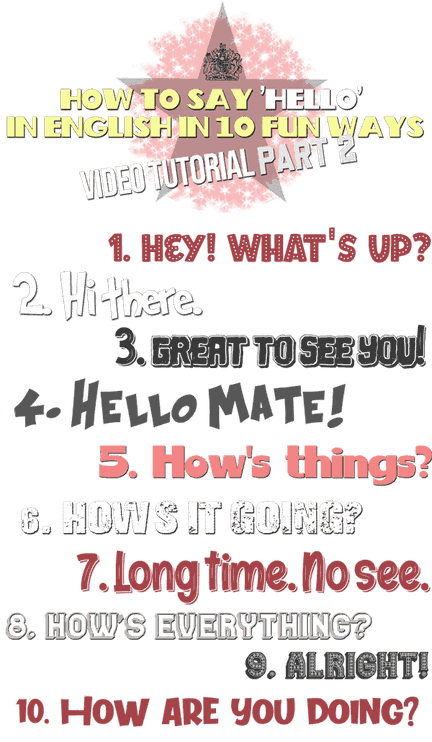
1. Hey! What's up?
2. Hi there.
3. Great to see you!
4. Hello mate!
5. How's things?
6. How's it going?
7. Long time. No see.
8. How's everything?
9. Alright!
10. How are you doing?

READ PART 1 & PART 2.
DO THE EXERCISES.
DISCUSS WITH YOUR TEACHER AND FRIENDS.
PLAY THE GAMES & ACTIVITIES.
GO TO PART 3.
FIND ALL THE ANSWERS, EXPLANATIONS AND VOCABULARY.
IRREGULAR VERBS - AUDIO

(TEXT VERSION)
IRREGULAR VERBS
(PRESENT / PAST / PAST PARTICIPLE)
be was/were been
beat beat beaten
become became become
begin began begun
bend bent bent
bet bet bet
bite bit bitten
blow blew blown
break broke broken
bring brought brought
build built built
burn burnt burned/burnt
buy bought bought
catch caught caught
choose chose chosen
come came come
cost cost cost
cut cut cut
deal dealt dealt
do did done
draw drew drawn
dream dreamt dreamt
drink drank drunk
drive drove driven
eat ate eaten
fall fell fallen
feed fed fed
feel felt felt
fight fought fought
find found found
fly flew flown
forget forgot forgotten
forgive forgave forgiven
freeze froze frozen
get got got
give gave given
go went gone
grow grew grown
have had had
hear heard heard
hit hit hit
hold held held
hurt hurt hurt
keep kept kept
know knew known
leave left left
let let let
lose lost lost
make made made
mean meant meant
meet met met
pay paid paid
put put put
read read read
ride rode ridden
ring rang rung
run ran run
say said said
see saw seen
sell sold sold
send sent sent
set set set
show showed shown
sing sang sung
sit sat sat
sleep slept slept
speak spoke spoken
spend spent spent
stand stood stood
steal stole stolen
swear swore sworn
take took taken
teach taught taught
tell told told
think thought thought
throw threw thrown
understand understood understood
wake woke woken
wear wore worn
win won won
write wrote written
MINI-PRONUCIATION COURSE
WHAT ARE THE ESSENTIAL ELEMENTS OF ENGLISH PRONUNCIATION?
Our first video explains about the schwa which is the #1 sound in English.
It is a weak, unstressed sound and it occurs in many words.
It is usually the sound in function words (grammar words) like articles (the, a and an) and prepositions (of, for, to, etc.)
Pronouncing the schwa sound correctly is the real secret of making your pronunciation sound more accurate and natural.
The phonemic symbol for this sound is /ə/ .
Now watch the video and listen to the examples:
THE #1 SOUND IN ENGLISH PRONUNCIATION: VIDEO TUTORIAL (Part 1)
MINI-PRONUNCIATION: VIDEO 1
Unstressed syllables
Any vowel letter (A E I O U) can be pronounced as the schwa. It just depends if it is the UNIMPORTANT or UNSTRESSED part.
In the word 'man' the letter 'a' has its full sound - represented by the symbol /æ/.
In 'postman' the syllable 'man' is not stressed and the letter 'a' is pronounced as schwa, represented by the symbol /ə/ .
Now practice these words that include the schwa sound /ə/:
- about - taken - memory - supply - emphasize - vitamin - celebrate - president - occur - campus - cut - love - sun - truck - stuff - salad - balance - assume - agree - problem:
MINI-PRONUNCIATION: VIDEO 2
Exercise Now practice saying these words out loud:
DOCTOR BANANA TOMORROW DIFFICULT SUMMER LEVEL PROTECT SURVIVE PUPIL THEATRE MEASURE WIZARD
THE SOUNDS OF ENGLISH - IPA PHONETICS CHART

MINI-PRONUNCIATION COURSE PART 2 IN NEXT LESSON: